Loading...
Rules
These rules only apply to unofficial competitions, and they supplement the general rules, with some points being
overridden.
U1. An unofficial competition may not have fewer than three competitors in total. Such competitions will be removed
without the results being published.
U2. After the competition, at least two photos of the setup (i.e. scrambling area, competition area, etc.) must be provided in the contest finished email thread.
U3. Mats are optional.
Event rules
These rules apply to each event individually. If an event is not listed here, it must follow the most relevant WCA Regulations, based on the nature of the event (i.e. one of the articles from A to F).
Face-Turning Octahedron
- Scrambling notation: the puzzle is oriented with one vertex facing directly in the front, such that four of the faces are directly above, below, to the left, and to the right of the front-facing vertex. These make up the U, F, L, and R faces, respectively. For the four faces on the back, B is adjacent to U, BL is adjacent to L, BR is adjacent to R, and D is adjacent to F.
- Scrambling orientation (see Regulation 4d of the WCA Regulations): scrambled starting with white (if not possible, then the lightest color) as the U face and green (if not possible, then the darkest possible color) as the F face.
- The scramble must be applied correctly. If the puzzle state is wrong, the scrambler must correct it (e.g. by solving the puzzle and applying the scramble sequence again).
- Misalignment penalty (see Regulation 10f of the WCA Regulations): at most 60 degrees.
The ranked average format is Average of 5
3x3x3 Team-Blind
- This is a team event (see above) and a fully blindfolded event (from the perspective of the solver) that involves a caller telling a blindfolded solver how to solve a 3x3x3 puzzle.
- There is no inspection time.
- The solver removes the cover from the puzzle after starting the timer.
- The sight blocker should be held in a way that allows the caller to see the puzzle.
- This may be coordinated with the judge. For example, the judge can stand across the table from the solver and hold the sight blocker from above. Alternatively, the judge can stand on one side of the solver (left or right) and try to hold the sight blocker in a less obstructive way, while the caller stands on the other side.
- As in Regulation B4c3, a suitable object may be used as a sight blocker instead of being held by the judge.
- The competitors may switch roles between attempts.
Description: Solve a 3x3x3 as a team with a solver who is blindfolded, and a caller who is not allowed to touch the cube or the solver's arms below the elbow. There is no inspection time.
The ranked average format is Average of 5
Mirror Blocks
- All sides of the puzzle must be clearly distinguishable from each other (i.e. have distinct thicknesses on each side).
- All pieces of the puzzle must only be distinguishable from each other by the thickness on each axis. There must be no other way to distinguish the pieces from each other, be that visually, by feel, or otherwise. Exception: the puzzle may have one logo on one of the center pieces.
- The orientation of the centers does not matter for determining the solved state.
- Scrambling orientation (see Regulation 4d of the WCA Regulations): scrambled starting with the thickest layer as the top face and the next thickest adjacent layer on the front face.
The ranked average format is Average of 5
Mirror Blocks Blindfolded
- This is a fully blindfolded event (see above).
- The rules for the Mirror Blocks event apply.
Description: Solve a Mirror Blocks by feel without memorization
The ranked average format is Mean of 3
Redi Cube
- Scrambling notation is the same as the Skewb puzzle (see Regulation 12h of the WCA Regulations) with the following additions: F (the layer around the closest visible vertex), UR (the layer around the upper-right vertex), UL (the layer around the upper-left vertex), D (the layer around the lowest visible vertex).
- Scrambling orientation is the same as the Skewb puzzle (see Regulation 4d of the WCA Regulations).
- Misalignment penalty (see Regulation 10f of the WCA Regulations): at most 60 degrees.
The ranked average format is Average of 5
Magic
- The solve consists of going from the unlinked ring pattern to the linked ring pattern, as configured in the original mass-produced puzzle.
- The WCA Regulations for Magic from 2010 apply.
The ranked average format is Average of 5
Master Magic
- The solve consists of going from the linked ring pattern to the unlinked ring pattern, as configured in the original mass-produced puzzle.
- The WCA Regulations for Magic from 2010 apply.
The ranked average format is Average of 5
3x3x3 Linear Fewest Moves
- This event is similar in nature to 3x3x3 Fewest Moves, but does not require a solution to be written down. Instead, the competitor directly applies moves to the puzzle, and the competitor's result is the number of moves in their solution, calculated using Outer Block Turn Metric.
- The time limit for each attempt is 2 minutes.
- Every competitor must have a judge.
- Moves must be counted using a smart cube under the supervision of the judge.
- If the smart cube malfunctions during the attempt, an extra attempt may be given, unless the malfunction happened due to an error by the competitor.
- The following smart cubes are supported: GiiKER, GoCube, Rubik's Connected, HeyKube, earlier Gan smart cubes.
- This website must be used for judging and tracking the number of moves. Instructions:
- Press "Connect" and connect to the cube.
- Enter the competitor's name.
- Apply the scramble.
- Press "Done with scramble" and then "Start" to start the attempt.
- When the competitor solves the puzzle, press "Stop" (optional) and then "Record Result" to record the attempt.
- Submit the attempt on Cubing Contests. You may submit the result with some attempts still missing, and later edit the same result to enter more attempts.
- Press "Reset scramble and alg" and start over with step 2 or 3 as appropriate.
- Once the competitor begins a move, all previous moves permanently remain part of the solution. The competitor may continue performing repetitions of the same move or its inverse, and these are combined into a single move. For example:
- R R → R2
- R R R → R'
- R R' → R0 (counts as 0 moves)
- F R R' F → F R0 F (counts as 2 moves)
Description: Solve a 3x3x3 cube with as few moves as possible without backtracking. The first solution is the final result. Smart cubes are used for counting the number of moves.
The ranked average format is Mean of 3
3x3x3 Speed-Blind
- This is a blindfolded event (see above), except the final result only includes the execution phase. The execution phase proceeds like a fully blindfolded event, with the following exceptions:
- The entire attempt (memorization + execution) is timed by a judge using a stopwatch.
- The judge starts the stopwatch while lifting the cover.
- The judge stops the stopwatch once the competitor stops the timer.
- A fixed time limit of 15 minutes applies to each attempt, as timed by the stopwatch.
- The stopwatch time is not used in the recorded result.
- Attempts for this event must not count towards a cumulative time limit. If a competitor is eligible for an attempt, they are entitled to the full 15 minutes, although their eligibility for an attempt may be determined by a cutoff.
- The recorded time of the execution phase, as timed by the timer, is the final recorded result.
Description: Memorize a 3x3x3 and solve it as fast as possible blindfolded. Only the solution part is timed.
The ranked average format is Mean of 3
The default round format is Best of 1
3x3x3 Match The Scramble
- Using a solved 3x3x3 cube (A) and a scrambled 3x3x3 cube (B), a competitor brings cube A to the same state as cube B without making turns on cube B.
- There is no inspection time.
Description: Using a solved 3x3x3 (A) and a scrambled one (B), bring cube A to the same state as cube B without making turns on cube B. There is no inspection time.
The ranked average format is Mean of 3
The default round format is Best of 3
3x3x3 With Feet
- The WCA Regulations for 3x3x3 With Feet from 2019 apply.
The ranked average format is Average of 5
Mini Guildford
- This is a relay event (see above).
- Solve these puzzles: 2x2x2, 3x3x3, 4x4x4, 5x5x5, Pyraminx, Megaminx, Skewb, Square-1, Clock, and solve a 3x3x3 one-handed.
- A box should be used to transport and cover all of the puzzles before the start of each attempt.
Description: Solve these puzzles: 2x2x2-5x5x5, Pyraminx, Megaminx, Skewb, Square-1, Clock, and solve a 3x3x3 one-handed
The ranked average format is Mean of 3
The default round format is Best of 3
2-man Mini Guildford
- This is a team event and a relay event (see above).
- As a team of two, solve these puzzles: 2x2x2, 3x3x3, 4x4x4, 5x5x5, Pyraminx, Megaminx, Skewb, Square-1, Clock, and solve a 3x3x3 one-handed.
- Any team member may do any of the puzzles/events.
- A box should be used to transport and cover all of the puzzles before the start of each attempt.
Description: As a team of two, solve these puzzles: 2x2x2-5x5x5, Pyraminx, Megaminx, Skewb, Square-1, Clock, and solve a 3x3x3 one-handed. It doesn't matter, who does which event.
The ranked average format is Mean of 3
The default round format is Best of 3
3x3x3 With Oven Mitts
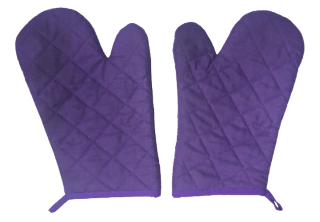
- Oven mitts must be of the standard type shown below, with one "pouch" for four fingers and a smaller "pouch" for the thumb.
- Competitors may only touch the puzzle while wearing the oven mitts.
- The Competitor doesn’t have to wear the oven mitts during inspection.
- Competitors may start and stop the timer using their forearms, but the oven mitts must not be in contact with the puzzle while starting or stopping the timer.
- Puzzle defects must be fixed while wearing the oven mitts.
The ranked average format is Mean of 3
3x3x3 Bets
- At the start of the attempt, the competitor writes down a time on the scorecard (without signing).
- The competitor does the attempt as normal, but trying to achieve a result faster than or equal to the predicted time.
- The recorded time is the one written down on the scorecard (the "bet"). Penalty for the final time on the timer being higher than the predicted time: DNF.
Description: Write down a time prediction on the scorecard and try to get a solve faster than or equal to the predicted time. If the solve is slower, the result is DNF.
The ranked average format is Mean of 3
The default round format is Best of 3
3x3x3 Cube Mile
- The event consists of solving four 3x3x3 cubes and running four laps (1609m total) in the following order: solve, lap, solve, lap, solve, lap, solve, lap. There is no inspection time.
- Solve: directly after the start signal, competitors uncover their puzzles and begin solving one of them. Competitors may advance through the 9m long transition zone (up to the finish line) during each solve.
- Competitors must solve one of the scrambled puzzles before starting each lap. Penalty: DNF. +2 penalties for a puzzle being one move away from the solved state are applied the same way as in the 3x3x3 Multi-Blind event.
- Laps: after solving each puzzle, competitors run a 400m lap. At the end of the lap, competitors continue to the next puzzle, or - after the final lap - the finish line.
- The transition zone is located in the last 9m of the lap, such that the end of the transition zone is at the same point as the finish line.
- Solve: directly after the start signal, competitors uncover their puzzles and begin solving one of them. Competitors may advance through the 9m long transition zone (up to the finish line) during each solve.
- Timing is done by the judge using a stopwatch (see Regulation B2f of the WCA Regulations).
- Scrambling is the same as in the 3x3x3 Multi-Blind event (each scramble is unique and in a random orientation), except that the number of puzzles is always the same.
- After scrambling, the puzzles are placed in the transition zone and completely covered until competitors remove the cover at the start of the attempt (same as in the 3x3x3 Multi-Blind event).
Description: Solve four 3x3x3 puzzles and run one mile. See the rules page for more information.
The ranked average format is Mean of 3
The default round format is Best of 1
3x3x3 Braille Cube Blindfolded
- Every side of the puzzle must have a unique set of tiles that can be distinguished by feel, as well as a unique color (same as a regular 3x3x3 Cube).
- This is a fully blindfolded event (see above).
Description: Solve a textured cube blindfolded. There is no inspection time.
The ranked average format is Mean of 3
Gear Cube
Please note the differences between the Gear Cube and the Super Gear Cube. The original Gear Cube has small center pieces with teeth, but they do not have any stickers. In contrast, the Super Gear Cube has two versions: one similar to the original Gear Cube, except with those small center pieces having colors, and one without the small center pieces made by QiYi that is functionally equivalent and has the same number of states.
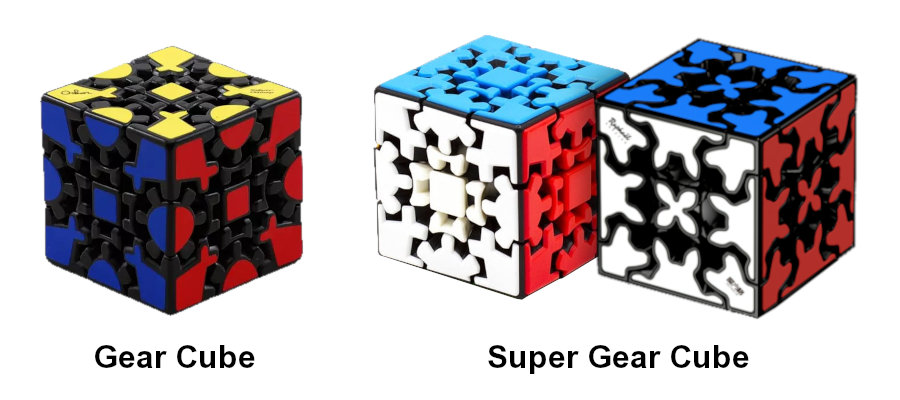
Description: Not to be confused with the Super Gear Cube. Please see the rules page for clarification.
The ranked average format is Average of 5
2x2x2 Fewest Moves
The time limit for each attempt is 8 minutes.
Description: The time limit for each attempt is 8 minutes
The ranked average format is Average of 5
4x4x4 Fewest Moves
The time limit for each attempt is 90 minutes.
Description: The time limit for each attempt is 90 minutes
The ranked average format is Mean of 3
The default round format is Best of 1
2x2x2 Mirror Blocks
- All sides of the puzzle must be clearly distinguishable from each other (i.e. have distinct thicknesses on each side).
- All pieces of the puzzle must only be distinguishable from each other by the thickness on each axis. There must be no other way to distinguish the pieces from each other, be that visually, by feel, or otherwise. Exception: the puzzle may have one logo on one of the corner pieces.
- Scrambling orientation (see Regulation 4d of the WCA Regulations): scrambled starting with the thickest layer as the top face and the next thickest adjacent layer on the front face.
The ranked average format is Average of 5
15 Puzzle
- Scrambling notation: the puzzle is oriented with the empty cell in the bottom right corner. Every move is determined based on how the empty cell is filled: U represents moving one piece up by one cell, filling the empty cell; R represents moving right, D - down, L - left. 2 represents moving two pieces together, 3 represents moving three pieces together. For example: R2 moves two pieces to the right. A move shifting multiple pieces together is still counted as one move.
- Solved state: all pieces are arranged in numerical order from lowest to highest, going from left to right, top to bottom, with the empty cell in the bottom right corner. The orientation of the pieces does not affect the solved state. Up to one piece may be flipped in place such that the number is not visible. Penalty for more than one flipped piece: DNF.
- There is no restriction on coloring pieces.
- If one move is required to bring the puzzle to its solved state, the puzzle is considered solved with a time penalty (+2 seconds).
- Acceptable misalignments: one or more pieces on the same line are at most 50% of the way to the neighboring cell.
- Required scrambler: https://tinyurl.com/15scrambler
The ranked average format is Average of 5
1x3x3 Cuboid
- Spinner versions of the puzzle are NOT allowed.
Description: Please note the differences between the standard 1x3x3 Cuboid (Floppy Cube) and the Super 1x3x3 Cuboid (Super Floppy Cube). The original Floppy Cube has four centers and four edges, but it only allows 180-degree moves. In contrast, the Super Floppy Cube has four centers and twelve edges (four additional ones within the center of each 3x3 face) and allows for 90-degree moves and shapeshifting.
The ranked average format is Average of 5
Super 1x3x3 Cuboid
- Spinner versions of the puzzle are NOT allowed.
- The permutation of the eight small inner pieces does not matter for determining the solved state.
Description: Please note the differences between the standard 1x3x3 Cuboid (Floppy cube) and the Super 1x3x3 Cuboid (Super Floppy cube). The original Floppy cube has four centers and four edges, but it only allows 180-degree moves. In contrast, the Super Floppy Cube has four centers and twelve edges (four additional ones within the center of each 3x3 face) and allows 90-degree moves.
The ranked average format is Average of 5
Event descriptions
These are all available event descriptions, excluding events that have rules. These can be used as reference to ensure consistency in how these events are held.
3x3x3 Multi-Blind Old Style
Description: Same as 3x3x3 Multi-Blind, except there is no time limit
The ranked average format is Mean of 3
The default round format is Best of 1
Mini Guildford Blindfolded
Description: Solve these puzzles blindfolded: 2x2x2-5x5x5, Pyraminx, Megaminx, Skewb, Square-1, Clock, and solve a 3x3x3 one-handed, also while blindfolded
The ranked average format is Mean of 3
The default round format is Best of 1
Kilo-Gigaminx Relay Blindfolded
Description: Solve a Kilominx, Megaminx, Master Kilominx and Gigaminx blindfolded
The ranked average format is Mean of 3
The default round format is Best of 1
3x3x3 Team-Blind With Inspection
Description: The old format of Team-Blind that has inspection time
The ranked average format is Average of 5
License
The contents of this page are available under the CC Attribution-ShareAlike 4.0 International license.